
ILAB Joins the Protest Against Amazon’s Bid to Control Top-Level Domain Names
Today, the International League of Antiquarian Booksellers has joined the numerous other organizations, such as the Authors Guild or the American Association of Publishers, objecting to the Internet Corporation for Assigned Names and Numbers (ICANN’s) plan to sell top-level domains to private companies. Online retail giant Amazon has bid to be the exclusive custodian of .book, .author and .read domains. Read more ...
Paris 2014 - 41st ILAB Congress
The ILAB and SLAM committees are very pleased to announce that the 41st ILAB Congress will run in Paris from the 13th to 16th April, 2014, to coincide with the 100th anniversary of SLAM. The Paris Congress will immediately follow the International Antiquarian Book Fair at the Grand Palais scheduled from 10th to 13th of April 2014. We hope that the very special program that we have planned will attract numerous visitors to Paris and we are looking forward to meeting our new colleagues and welcoming old friends.
Anne Lamort, President SLAM, Tom Congalton, President ILAB
16th ILAB Breslauer Prize for Bibliography
The 16th ILAB Breslauer Prize for Bibliography will be awarded in 2014 to one or more books about books published in any language and in any part of the world between 2009 and 2012. Publishers, librarians, collectors, antiquarian booksellers and all book lovers are very welcome to submit books to the prize until the end of April 2013 by sending a single copy to the Prize Secretary.
Support scholarship! Submit books to the most prestigious prize until April 2013!
The World’s Expert Antiquarian Booksellers - In 1 Book!
The new edition of the ILAB Directory contains all names, addresses and specialities of the ILAB dealers who are organized in 22 national associations and who are located in 32 countries all over the world. Have a look!
“Book collecting is and almost always has been a vibrant, exciting and engaging pastime"
"It’s our job to make others understand that.” An interview with ILAB President Tom Congalton about his career, his favourite books, Between the Covers, collecting, ILAB and the future of the trade. Read it!
ILAB Booksellers on Video
"A wonderful snapshot of the rich history of both the ABAA and the rare book trade" - ILAB is proud to present the video archive project by Michael Ginsberg and Taylor Bowie. Recently added: interviews with two amazing ladies: Marguerite Goldschmidt and Florence Shay.
"Out of the classroom and into the world" - ILAB Internships
ILAB has launched an internship program for young antiquarian book dealers. Alena Lavrenova, Anastasya Zhikhareva, and other young antiquarian booksellers from Russia, spent several weeks in Austria, Hungary, Germany, Netherlands, Australia and the United States. Read their exciting reports and join our new Facebook Group!
The World's Best Booksellers Met in Switzerland
From 22 to 26 September the presidents of 22 national antiquarian booksellers' associations and rare book dealers from all over the world met for their 40th Congress in Lucerne. Besides the meetings and elections on Saturday, Sunday and Tuesday, they climbed high mountains and dark caves and visited Switzerland's most outstanding museums and private collections. Read the online diary!
Old and Rare Books. From ILAB: the one stop FREE App for all lovers of rare books
The International League of Antiquarian Booksellers (ILAB) has launched an ILAB Moile App which is now available in the Apple Store and the Android Market. Search for “ILAB rare books” or “International League of Antiquarian Booksellers” to find the free App ready to install on your phone.
|
Book FairsRare Books - Next Fairs
-
27 Jun 2013 - 03 Jul 2013
Masterpiece London, perfectly situated at the peak of the capital’s summer season, brings together exhibitors from across the world renowned for specialising in art, antiques and design of... [+] More
-
26 Jul 2013 - 28 Jul 2013
The Australian and New Zealand Association of Antiquarian Booksellers is proud to present its 40th Australian Antiquarian Book Fair, to be held from Friday July 26 to Sunday July 28 in the... [+] More
EventsRare Books - Next Events
-
02 Jun 2013 - 25 Aug 2013
Kurt Schwitters (1887-1948) was one of the most influential European avant-garde artists to come to prominence in the interwar years. Associated at various times with DADA, Constructivism and... [+] More
BooksellersAntiquarian Booksellers
-
Cambridge - UNITED KINGDOM
Specialties: Children's books, Illustrated books, Literature, Natural history, Topography, Travel
[+] More
Rare Book Gallery
-
A New System of Chemical Philosophy
DALTON, John
Bookseller: Jonathan A. Hill, Bookseller, Inc.
Eight engraved plates (several of the plates in Vol. I are a little foxed). vi, [1], 220 pp.; 4 p.l., 221-560 pp.; xii, 357 pp., [3] pp. of ads.... More
Eight engraved plates (several of the plates in Vol. I are a little foxed). vi, [1], 220 pp.; 4 p.l., 221-560 pp.; xii, 357 pp., [3] pp. of ads. Three vols. 8vo, cont. cloth-backed boards (boards of each vol. are different but spines are uniform), manuscript labels on spines, uncut. Manchester: R. Bickerstaff, 1808-10 [Vols. I & II], G. Wilson, 1827 [Vol. III]. First edition and a fine complete set. Complete sets in matching bindings (the boards of each volume are different -- understandably so due to the long period of publication -- but the spines are uniform). "A milestone work in the history of chemistry, in which Dalton announced his revolutionary atomic theory and his laws of definite and multiple proportions. These fundamental laws greatly assisted the establishment of the composition and formulae of numerous inorganic and organic compounds then known and laid one of the firmest foundations ever for the advance of chemistry in the nineteenth century...The book is very rare when complete with the tree parts and the required half title to volume II, part 1."-Neville, I, p. 322-(the mentioned half-title is present in our copy). In this set a contemporary manuscript chemical table is mounted on the rear pastedown of Part I. A printed broadsheet is also mounted on the front pastedown of the same volume entitled "Atomic Symbols, by John Dalton...explanatory of a Lecture given by him to the Members of the Manchester Mechanics' Institution, 19th October 1835." Fine and handsome uncut set, in matching bindings, and preserved in a morocco-backed box. From the libraries of Haskell F. Norman and Joseph A. Freilich with bookplates. ❧ Dibner, Heralds of Science, 44. Horblit 22. Printing & the Mind of Man 261. . Less
Price: 75000.00 USD
-
THE AMERICAN ATLAS; OR, A GEOGRAPHICAL DESCRIPTION OF THE WHOLE CONTINENT OF...
Jefferys, Thomas:
Bookseller: William Reese Company - Americana
London: Printed and sold by R. Sayer and J. Bennett, 1778.. Twenty-three engraved maps on thirty sheets, handcolored in outline. Folio, 21 3/4 x 15... More
London: Printed and sold by R. Sayer and J. Bennett, 1778.. Twenty-three engraved maps on thirty sheets, handcolored in outline. Folio, 21 3/4 x 15 1/2. Expertly bound to style in 18th-century half russia over original marbled paper boards, spine gilt in seven compartments with raised bands, red morocco lettering piece. In a black morocco backed box, lettered in gilt. Provenance: Henry Tomkinson (armorial bookplate). In a half morocco box. The very rare 1778 issue of THE AMERICAN ATLAS, the most important 18th-century atlas for America, and an irreplaceable snapshot of the land as it was during the birth of the United States. Walter Ristow characterizes it as a "geographical description of the whole continent of America, as portrayed in the best available maps in the latter half of the eighteenth century...as a major cartographic reference work it was, very likely, consulted by American, English, and French civilian administrators and military officers during the Revolution." As a collection, THE AMERICAN ATLAS stands as the most comprehensive, detailed, and accurate survey of the American colonies at the beginning of the Revolution. Many of the elements that make up THE AMERICAN ATLAS came into being as a result of the British need to understand the geographic and social layout of their colonies after their victory in the French and Indian War of 1756-63. The maps that resulted from the numerous surveys proved to be by far the best contemporary records of the region. Among these distinguished maps are Braddock Meade's "A Map of the Most Inhabited Parts of New England," the largest and most detailed map of New England that had yet been published; a map of "The Provinces of New York and New Jersey" by Samuel Holland, the surveyor general for the northern American colonies; William Scull's "A Map of Pennsylvania," the first map of that colony to include its western frontier; Joshua Fry and Peter Jefferson's "A Map of the Most Inhabited part of Virginia," the best colonial map for the Chesapeake region; and Lieut. Ross' "Course of the Mississipi," the first map of that river based on British sources. Jefferys was the leading British cartographer of the 18th century. From about 1750 he published a series of maps of the British American colonies. As geographer to the Prince of Wales, and after 1761, geographer to the King, Jefferys was well placed to have access to the best surveys conducted in America, and many of his maps held the status of "official work." Jefferys died on Nov. 20, 1771, and in 1775 his successors, Robert Sayer and John Bennett, gathered these separately issued maps together and republished them in book form as THE AMERICAN ATLAS. The first edition with only twenty-two maps on twenty- nine sheets appeared in 1775, and there were subsequent editions in 1776 and 1778. The maps are as follow (many of the maps are on several sheets, and in the Index each individual sheet is numbered; the measurements refer to the image size): 1-3) Braddock Meade (alias John Green): "A Chart of North and South America, including the Atlantic and Pacific Oceans. Published 10 June 1775." Six sheets joined into three, 43 1/2 x 49 1/2 inches. This great wall map of the Western Hemisphere was chiefly issued to expose the errors in Delisle and Buache's map of the Pacific Northwest, published in Paris in 1752. STEVENS & TREE 4(d). 4) Imperial Academy of St. Petersburg: "The Russian Discoveries. Published March 2nd 1775." One sheet, 18 x 24 1/8 inches. The first official mapping results of the explorations of Bering and Chirikof in Siberia and the Pacific Northwest were issued by the Russian Imperial Academy in 1758. These corrected the earlier incorrect maps including the mythical discoveries of Admiral Fonte. This is a British version of that map. 5-6) Thomas Pownall after E. Bowen: "A New and Correct Map of North America, with the West India Islands. Published 15 February 1777." Four sheets joined into two, 45 1/4 inches. Thomas Pownall updated Bowen's North America map of 1755. Pownall's version included the results of the first Treaty of Paris drawn up after the end of the French and Indian War. STEVENS & TREE 49(f). 7) Thomas Jefferys: "North America from the French of Mr. D'Anville, Improved with the English Surveys Made since the Peace. Published 10 June 1775." One sheet, 18 x 20 inches. STEVENS & TREE 51(c). 8) Samuel Dunn: "A Map of the British Empire in North America. Published 17 August 1776." Half sheet, 18 3/4 x 12 inches. STEVENS & TREE 53(b). 9) Thomas Jefferys: "An Exact Chart of the River St. Laurence from Fort Frontenac to the Island of Anticosti...Published 25 May 1775." Two sheets joined into one, 23 1/2 x 37 inches. STEVENS & TREE 76(d). 10) Sayer & Bennett: "A Chart of the Gulf of St. Laurence...Published 25th March 1775." One sheet, 19 1/2 x 24 inches. 11) "A Map of the Island of St. John in the Gulf of St. Laurence...Published 6 April 1775." One sheet, 15 x 27 1/4 inches. 12) James Cook and Michael Lane: "A General Chart of the Island of Newfoundland...Published 10th May 1775." One sheet, 21 1/2 x 22 inches. James Cook went on to gain renown for his Pacific exploration. 13) "A Chart of the Banks of Newfoundland...Published 25 March 1775." One sheet, 19 1/2 x 26 inches. Based on the surveys of James Cook (see above), Chabert, and Fleurieu. 14) Thomas Jefferys: "A New Map of Nova Scotia and Cape Breton Island with the Adjacent Parts of New England and Canada...Published 15 June 1775." One sheet, 18 1/2 x 24 inches. Originally published in 1755, at the beginning of the French and Indian War, this map "proved to be important in evaluating respective French and British claims to this part of North America" (Ristow). England gained sole possession of the region by the Treaty of Paris, 1763. STEVENS & TREE 66(c). 15-16) Braddock Meade (alias John Green): "A Map of the Most Inhabited Part of New England. Published November 29, 1774." Four sheets joined into two, 38 3/4 x 40 3/4 inches. The first large-scale map of New England. "The most detailed and informative pre-Revolutionary map of New England...not really supplanted until the nineteenth century" (NEW ENGLAND PROSPECT 13). STEVENS & TREE 33(e). 17) Capt. [Samuel] Holland: "The Provinces of New York and New Jersey, with Part of Pensilvania...Published 17 Aug. 1776." Three insets: "A plan of the City of New York," "A chart of the Mouth of Hudson's River," and "A Plan of Amboy." Two sheets joined, 26 1/2 x 52 3/4 inches. An important large-scale map of the Provinces of New York and New Jersey, by Samuel Holland, surveyor general for the Northern English colonies. With fine insets including a street plan of colonial New York City. STEVENS & TREE 44(d). 18) William Brassier: "A Survey of Lake Champlain, including Lake George, Crown Point and St. John. 5 August 1776." Single sheet, 26 3/4 x 18 3/4 inches. Second state including naval activity on the lake up until Oct. 13, 1776. STEVENS & TREE 25(b). 19) "A New Map of the Province of Quebec, according to the Royal Proclamation, of the 7th of October 1763. From the French Surveys Connected with those made after the War, by Captain Carver, and Other Officers. 16 February 1776." One sheet, 19 1/4 x 26 1/4 inches. STEVENS & TREE 73(a). 20) William Scull: "A Map of Pennsylvania Exhibiting not only the Improved Parts of the Province but also its Extensive Frontiers. Published 10 June 1775." Two sheets joined, 27 x 51 1/2 inches. The first map of the Province of Pennsylvania to include its western frontier. All earlier maps had focused solely on the settled eastern parts of the colony. 21-22) Joshua Fry and Peter Jefferson: "A Map of the Most Inhabited Part of Virginia, containing the Whole Province of Maryland...1775." [nd]. Four sheets joined into two, 32 x 48 inches. "The basic cartographical document of Virginia in the eighteenth century...the first to depict accurately the interior regions of Virginia beyond the Tidewater. [It] dominated the cartographical representation of Virginia until the nineteenth century" - Verner. STEVENS & TREE 87(f). 23-24) Henry Mouzon: "An Accurate Map of North and South Carolina with their Indian Frontiers. Published May 30, 1775." Four sheets joined into two, 40 x 54 inches. "The chief type map for [the Carolinas] during the forty or fifty years following its publication. It was used by both British and American forces during the Revolutionary War" - Cumming. STEVENS & TREE 11(a). CUMMING 450. 25) Thomas Jefferys: "The Coast of West Florida and Louisiana...The Peninsula and Gulf of Florida. Published 20 Feby. 1775." Two sheets joined into one, 19 1/2 x 48 inches. Stevens & Tree 26(b). A large-scale map of Florida, based upon the extensive surveys conducted since the region became a British possession by the Treaty of Paris, 1763. 26) Lieut. Ross: "Course of the Mississipi...Taken on an Expedition to the Illinois, in the latter end of the Year 1765. Published 1 June 1775." Two sheets joined into one, 14 x 44 inches. The first large- scale map of the Mississippi River, and the first based in whole or part upon British surveys. STEVENS & TREE 31(b). 27) Thomas Jefferys: "The Bay of Honduras. Published 20 February 1775." One sheet, 18 1/2 x 24 1/2 inches. 28-29) J.B.B. D'Anville: "A Map of South America...Published 20 September 1775." Four sheets joined into two, 20 x 46 inches. 30) Juan de la Cruz Cano y Olmedilla and others: "A Chart of the Straits of Magellan. Published 1 July 1775." One sheet, 20 1/2 x 27 inches. HOWES J81, "b." PHILLIPS ATLASES 1165, 1166. SABIN 35953. STREETER SALE 72 (1775 ed). Walter Ristow (editor), THOMAS JEFFERYS The American Atlas LONDON 1776, facsimile edition (Amsterdam 1974). Less
Price: 140000.00 USD
-
Candide, Ou L'Optimisme
VOLTAIRE (Francois-Marie Arouet)
Bookseller: Between The Covers
(Geneva: No publisher) 1759. First edition, the true first printing preceding all others. 12mo. Text in French. Contemporary full mottled French... More
(Geneva: No publisher) 1759. First edition, the true first printing preceding all others. 12mo. Text in French. Contemporary full mottled French calf, spine elaborately gilt, red morocco spine label gilt. Bound (as customary) without the final blank (N7) and the instructions to the binder (N8), very short hairline split at one joint, but still a beautiful just about fine copy, not rebacked or restored in any way. Custom cloth chemise and clamshell case. The first printing is rare, this being one of only 13 known copies of the authentic first edition, preceding 17 other editions subsequently published in 1759 (per Wade, Barber, and Weissman). Printing and the Mind of Man 204 (one of only about a dozen novels included in the survey). Less
Price: 100000.00 USD
-
Astronomicon
MANILIUS
Bookseller: Jonathan A. Hill, Bookseller, Inc.
Roman letter, 72 leaves, 30 lines, five fine woodcut initials with a white interlaced branchwork design on a black ground. Guide letters for the... More
Roman letter, 72 leaves, 30 lines, five fine woodcut initials with a white interlaced branchwork design on a black ground. Guide letters for the smaller initials. Small 4to (200 x 147 mm.), antique blindstamped calf (extreme inner margins of five or six leaves expertly & almost invisibly strengthened, verso of final leaf a little dusty). Nuremberg: Johann M?r of K?sberg (Regiomontanus), [ca. 1473-74]. First edition of the first printed book on astronomy; of the greatest rarity with only two other copies having appeared at auction in the last fifty years. "The work of Manilius was the main exemplar of that 'poetic astronomy' which exerted such a powerful influence on German humanist thought from Regiomontanus to Conrad Celtis and beyond."-Rose, The Italian Renaissance of Mathematics, p. 105. Regiomontanus envisioned the new invention of the printing press as one of the chief means of restoring mathematics and astronomy. It was this book and the others in Regiomontanus' publishing program with which he formally launched the renaissance of astronomy and mathematics, issuing the most important texts in edited and corrected editions. The Astronomicon describes the sphere, zodiacal and other constellations, great circles, comets, and astral influences on human beings. It put forward a number of sound astronomical hypotheses, especially relating to the nature of the stars, and became an important textbook, representing the most advanced views on astronomy of ancient Roman times. The text of the poem, composed in the first century A.D., had only recently been discovered when it received this, its first printing. This book was printed at the press of Regiomontanus, the foremost astronomer of the time, who established the first observatory in Europe, and was the first publisher of astronomical and mathematical literature. He had finally settled in Nuremberg after a career in Italy under Cardinal Bessarion and, more recently in Vienna, as librarian to Mathias Corvinus. The press was probably a private one and not a commercial office; it was the first scientific publishing house. Its output was limited to some ten titles, all issued within a year and a half, of which this is the only one to bear a full colophon. The type, apparently never used again, seems to have been cut in imitation of the smaller type of Sweynheym and Pannartz at Rome. It is amongst the most elegant of the early roman types used in Germany. This and the second edition (Bologna: ca. 1474) were printed from independent sources. The great modern editor of Manilius, A.E. Housman, considered this the more important textually and believed that Regiomontanus must have corrected the text himself as so many corrections are not to be found in any surviving manuscript (Housman, V, p. xvii). Neither of Manilius' other great editors, Scaliger and Bentley, knew of this edition, and so Regiomontanus' corrections were incorporated into the text only in the 20th century. This is an extremely rare book. As we have mentioned above, only two other copies have appeared at auction in the past fifty years. The ISTC-in-progress records only the Chapin, Harvard, Huntington, and Morgan Library copies in the U.S. Fine copy. 18th-century crowned stamp on outer margin of title and foot of final leaf. ❧ B.M.C., II, p. 456. Goff M-202. Klebs 661.1. Lalande, p. 9-"Le premier livre d'astronomie qu'on imprima." Stillwell, The Awakening Interest in Science during the First Century of Printing 1450-1550, 75. . Less
Price: 175000.00 USD
|
-
Online: Dochnahl’s „Bibliotheca Hortensis“ [+] More
-
“To sit alone in the lamplight with a book spread out before you, and hold intimate converse with men of unseen generations – such is a pleasure beyond compare.” (Kenko Yoshida) [+] More
-
"For many people in the west mention of Japanese woodblock prints brings to mind the beautiful single sheet colour examples by artists such as Hokusai, Hiroshige and the many other artists of extraordinary skill working during the 18th and 19th centuries. Immense pleasure can also be gained from looking a little further and discovering the plethora of games, decorative papers, books, calendars, lists, news-sheets, maps, advertising, and ephemeral material of every kind that was published using woodblock printing methods during the Edo and Meiji periods." Sally Burdon's collecting tip is one of the highlights of BookFare 2, the recently published newsletter of the Australian & New Zealand Association of Antiquarian Booksellers (ANZAAB). Read the article and subscribe to further issues! [+] More
-
Now, for those of you unfamiliar with David A. Noebel’s theories of Commie Rock-n-Roll Mind Control, here’s a sample: “…The destructive music of the Beatles merely reinforces the excitatory reflex of the youth to the point where it crosses the built-in inhibitory reflex. This in turn weakens the nervous system to a state where the youth actually suffers a case of artificial neurosis. And the frightening, even fatal, aspect of this mental breakdown process is the fact that these teenagers, in this excitatory, hypnotic state, can be told to do anything – and they will… [+] More
-
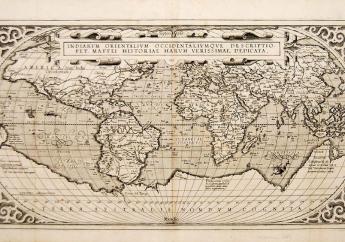
“He was entrusted to guard Sweden’s cultural heritage, but instead this senior librarian spent years surreptitiously stealing and selling scores of its rare and precious books. When the thief, Anders Burius, was finally caught in 2004, the media called him the “Royal Library Man,” and his sensational crime and subsequent suicide became the subjects of a government inquiry, a radio documentary and, last year, a television mini-series. Now, for the first time, one of the missing books — the earliest printed atlas of the Americas — has been recovered by Sweden’s Royal Library after a librarian there noticed that it was being offered for sale …” [+] More
-
As far as successful British 19th Century writers were concerned Charles Dickens was the commercial equivalent of J. K. Rowling. He was huge, without doubt the most popular novelist of his time and place. There are numerous possible reasons for his overwhelming popularity, but one deciding factor would be the broad nature of his readership. He wrote for everyone, and he did it at a shilling a go. [+] More
|